
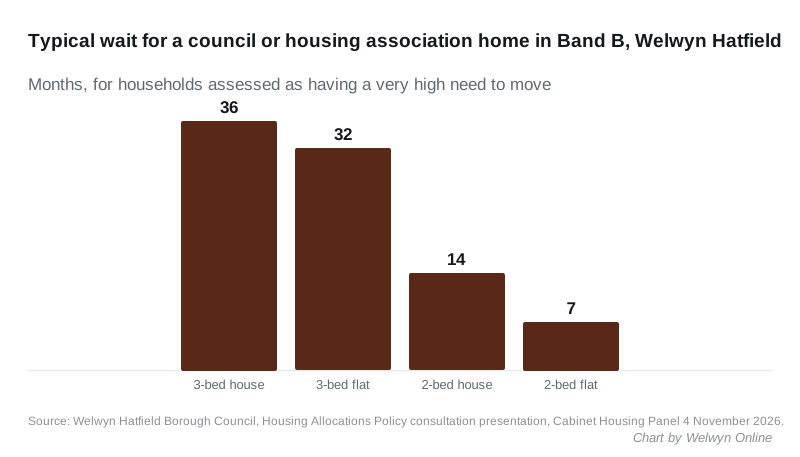
3,750 households are on the Welwyn Hatfield housing register; a Band B family waits 36 months for a 3-bed house. The council wants to change who gets priority.
Welwyn Hatfield Borough Council wants to change the rules that decide who gets a council or housing association home. The proposals go to its Cabinet Housing Panel on Wednesday 4 November at 7.30pm, which is being asked to approve a consultation.
The changes would affect the 3,750 households on the borough’s housing register. No final decision has been made.
Who is waiting, and for how long
The council’s consultation presentation sets out the pressure on the list:
- 2,767 households are looking for a social home
- 983 are existing tenants who want to move
- applications rose 14.6% last year
- 16 households in temporary accommodation need two bedrooms but can bid for three
Waits are longest for family homes. A household in Band B, the second-highest priority, typically waits three years for a three-bedroom house.
The five changes
The draft policy with the changes marked runs to 38 pages. These are the main proposals.
1. People placed here by another council. Living in the borough would not count as a local connection until someone had been placed here continuously for at least two years. Until then, the council that placed them stays responsible for rehousing them. The council says local connection rules for everyone else, including renters, would not change.
2. Band A, urgent need to move.
- Housing association tenants whose homes are being demolished or redeveloped would get Band A, as council tenants already do. This applies where the council will get to nominate tenants for the rebuilt homes.
- Being legally overcrowded would no longer bring Band A automatically. Bedroom shortage, medical needs and social needs would be weighed together instead.
- Band A applicants would have their bidding watched for three months. If they are not bidding for suitable homes, the council could start bidding on their behalf.
3. Band B, very high need to move.
- Today a council or housing association tenant with children gets Band B for living in a flat above the third floor, even with a lift. The draft limits this to households with a child under five, or someone pregnant, in a flat above the third floor without lift access.
- The current Band B rule for families in a bedsit would not be kept. The draft says this needs confirming through the consultation.
- A new route into Band B: where an occupational therapist confirms the home cannot be adapted to meet the household’s medical needs.
4. Homeless households. Automatic bidding would start earlier. At the moment it usually begins once the council accepts the main homelessness duty. Under the draft it would also cover people owed a prevention or relief duty, who are threatened with or facing homelessness.
5. First baby. A temporary arrangement lets people expecting their first child bid for a two-bedroom home once they have a MATB1 maternity certificate. That would become permanent, with an affordability check before any offer.
Rules for Armed Forces members would also change, to match national guidance from December 2024. The five-year limit on protection from local connection rules for former regulars would go. Separated or divorced partners who must leave military housing would be covered.
The draft also asks two open questions, with no rule proposed yet: whether homeless families should be offered suitable two-bedroom, four-person homes directly, and whether people helped into private renting should stay on the register.
Who will be asked
The council calls this a “light-touch” consultation. Its report to the panel says an online questionnaire will go to:
- the council’s Residents’ Panel
- a sample of people on the housing register
- households directly affected by the changes
- ward councillors, the local MP and some partner organisations
The timetable in the report:
- Late November to December 2026: four-week consultation
- January 2027: responses analysed
- February 2027: final policy back to the panel for approval
- March 2027: new rules take effect
The meeting papers are on the council’s democracy site.
What it means for you
- If you are on the register in Band B because of a high-floor flat or a bedsit, these are the changes most likely to affect you. Read section 5.5 of the draft.
- If you were placed in the borough by another council, the two-year rule matters to you.
- If you are not invited to respond, you can still write to your ward councillor before the panel meets on 4 November or while the consultation runs.
Planning and housing developments in the borough are on our planning news page.
Have your say