
The final Local Plan sets out 4,428 homes for Welwyn Garden City and 2,978 for Hatfield. Full Council votes 16 September, then a six-week consultation.
Welwyn Hatfield Borough Council has published the version of its Local Plan it intends to send to a government inspector. It proposes 4,428 new homes in Welwyn Garden City and 2,978 in Hatfield by 2043.
The report went online on Tuesday 25 August. It is the Regulation 19 stage, the last one before the plan leaves the council’s hands. Three meetings decide whether it goes out for consultation: the Cabinet Planning and Parking Panel on Thursday 3 September, Cabinet on Tuesday 8 September and Full Council on Wednesday 16 September.
If Full Council approves it, a six-week consultation follows in September and October. The council then aims to submit the plan to the Secretary of State before 31 December 2026, with examination in 2027 and adoption in 2027 or 2028.
Where the homes would go
The officer report sets out how growth is shared between the borough’s settlements:
- Welwyn Garden City: 4,428 dwellings
- Hatfield: 2,978
- Cuffley: 1,119
- Brookmans Park: 981
- Little Heath: 585
- Potters Bar: 425
- Welham Green: 350
- Welwyn: 284
- Woolmer Green: 211
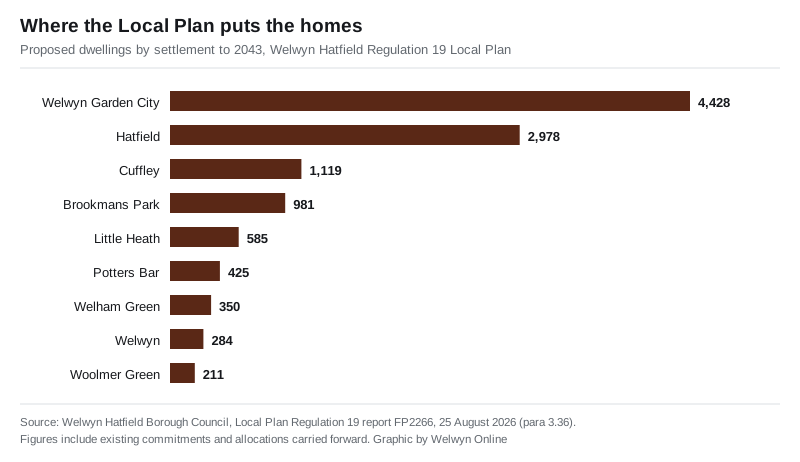
Those figures include homes already committed and existing allocations carried over, not only new sites.
The named sites
The site allocations schedule names every site and gives a capacity for each. The largest in Welwyn Garden City are:
- Broadwater Road West, covering the former Shredded Wheat factory and Bio Park: 1,300 homes
- South east of the town, land adjacent to the A414 Southern Fields: 925
- North East of Welwyn Garden City, the Panshanger extension: 870
- Creswick: 340
- Town Centre North at Campus East: 210
- Campus North: 170
Panshanger is not a new idea. The schedule records outline planning permission already granted in two phases, for up to 650 and up to 210 homes. A reserved matters application covering 169 of them is with the council now. It is also a different site from the council-owned Panshanger Golf Course, where Cabinet dropped a 500-home proposal this month.
In Hatfield, North West Hatfield is by far the biggest at 2,000 homes and mixed use. Hatfield town centre is down for 300 and College Lane for 115.
One entry will be new to most residents. Land at Gosling Sports Park, off Stanborough Road, is allocated for about 100 homes on a 10.01 hectare site, with completions expected in years 10 to 15. The schedule says any housing there must be brought forward through a masterplan for the whole sports park and must show how it supports the park’s long-term viability. Part of the site sits inside the Welwyn Garden City Conservation Area.
The plan does not meet the full need
The government’s standard method puts local housing need at 822 homes a year, or about 14,796 by 2043. The plan identifies 13,778, which is 1,018 short.
That is deliberate. Officers write that rather than allocate enough land for the whole period, the council is identifying a supply capable of supporting roughly ten years of building after adoption. Certainty over individual sites “reduces significantly over longer timescales”, the report says, and meeting the full figure would mean either more building in smaller villages or an entirely new settlement.
The 13,778 breaks down as 1,132 homes with permission or committed, 6,988 from existing allocations carried forward, 3,628 from new allocations and 2,030 from windfall. The report is not consistent on the middle figure: paragraph 3.26 gives 3,628 for new allocations while paragraph 3.40 says they are expected to contribute about 3,836. The Panshanger yield also differs between documents, at 870 in the schedule and 875 on the site’s own page.
Officers also point at local government reorganisation, arguing that decisions about growth beyond the first ten years “may be more appropriately considered through future planning arrangements operating across a larger geography”.
What it means for you
The consultation is not a vote on whether you like the plan. At Regulation 19 the council must publish what it believes is legally compliant and sound, and representations are judged against those tests: whether the plan is positively prepared, justified, effective and consistent with national policy. A comment that simply objects to a site carries little weight unless it engages with one of those four.
The council’s Local Plan portal is live, but as of today it only takes an email address for updates. The window to make representations opens after the 16 September Full Council meeting.
If you want to hear the arguments first, the Cabinet Planning and Parking Panel meets at 7.30pm on Thursday 3 September. It sits in the Council Chamber at the Council Offices, The Campus, Welwyn Garden City, AL8 6AE, and the meeting is webcast.
The earlier Regulation 18 consultation ran from 12 February to 26 March 2026. The council says it drew significant public interest and shaped this version.
Whatever is submitted, the final call is not the council’s. A planning inspector appointed by the Secretary of State decides whether the plan is sound, and can require changes before it can be adopted.
For what is being decided week by week, see our Welwyn Hatfield planning news page.
Have your say