
Welwyn Hatfield council now needs £953,000 of savings by 2030, half February's £1.9m. Fees rise at least with inflation; council tax is modelled at £5 a year.
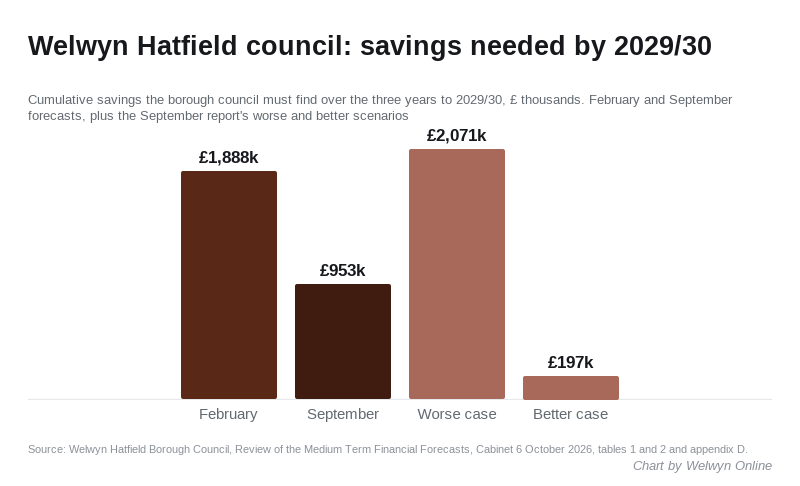
Welwyn Hatfield Borough Council now expects to need £953,000 of savings over the three years to 2029/30. In February the figure was £1.888 million. The gap has roughly halved in eight months.
The new forecast went to the council’s Cabinet on Tuesday 6 October. It is in a report by the council’s finance director, Richard Baker, which starts the budget process for 2027/28.
Updated 11 November: the council’s half-year budget report, noted by Cabinet on 3 November, forecasts a net contribution of £2.434m to the general fund reserve this year, £2.499m less use of balances than planned. The council housing account is forecast to close at £3.328m, £1.015m worse than budget.
Updated 15 October: Cabinet approved all three recommendations unchanged. It noted the savings target, approved the budget principles and let the finance director agree a business rates pool.
The report also sets the rules for that budget. Fees and charges the council sets itself are to rise by at least inflation. Its forecasts assume council tax goes up by £5 in each of the next three years.
The savings needed, year by year
The council has a legal duty to set a balanced budget every year. The forecasts show how much it would have to save, or raise, to do that.
| Year | February forecast | September forecast |
|---|---|---|
| 2027/28 | £566,000 | £118,000 |
| 2028/29 | £676,000 | £464,000 |
| 2029/30 | £647,000 | £371,000 |
| Total by 2029/30 | £1,888,000 | £953,000 |
The report also tests two other outcomes, in its appendix D:
- Worse case: higher inflation, extra pressures and less government funding. The gap would be £746,000 next year and £2.071 million by 2029/30.
- Better case: lower inflation and the most generous funding. The council would have £219,000 to spare next year and need only £197,000 by 2029/30.
Why the gap has shrunk
The report gives two main reasons. The government has given councils an indicative three-year funding settlement, which the report says “significantly improved the position”. And payments under the new packaging scheme, extended producer responsibility, came in higher than expected.
The changes for 2027/28 listed in the report’s appendix A include:
- £350,000 more in packaging scheme payments, which the report expects to fall over time
- £255,000 saved on existing budgets from the purchase of Gatehouse, in its second year
- £96,000 under budget on contract inflation
- £1.294 million of homelessness prevention funding, matched by the same amount of spending
Some costs are going the other way:
- £150,000 more for the materials recovery facility that sorts recycling
- £130,000 more for minor works and repairs, after a new contract
- £80,000 more for elections, from postage and printing
- £77,000 more for water, which the report calls “a national matter”
- a one-off £1.5 million budget for local government reorganisation
That last item is for the planned replacement of Hertfordshire’s councils. The government has paused that review. The report says the money set aside for it will be revisited but is “reasonable” for now.
The council’s reserves
Closing the 2025/26 accounts added £0.796 million to the council’s general fund balances. It started this year with £8.861 million in general revenue reserves.
The report calls that a “strong financial position”. Its housing account, which aims to keep about 9,000 council homes, held reserves of £3.157 million.
What it means for you
The report sets 12 principles for next year’s budget. The ones residents will notice:
- Fees and charges rise. All fees the council sets itself go up by at least inflation, “except in exceptional circumstances”. Charges fixed by law are not covered.
- Services face review. Statutory and public-facing services will be protected “wherever possible”. But the report adds that “there may need to be difficult decisions taken in this area”.
- Council tax. The forecasts assume the borough’s share rises by £5 a year. The report does not say which band that figure applies to. The borough takes only a small part of each bill, as our council tax bands page shows.
- Building projects. The whole capital programme will be reviewed. Schemes may be cut back or dropped to reduce borrowing.
For council tenants, the report names voids, damp and mould as continuing pressures on the housing budget.
What happens next
Cabinet noted the savings target and approved the budget principles. It also delegated authority to the Executive Director (Finance and Transformation) to agree applications for a business rates pool “if in the financial interests of the Council”, according to the decision record.
The agenda and papers link to a webcast of the meeting.
Officers will now draw up savings options over the autumn. They go to Cabinet in January 2027, and the budget and council tax are set by Full Council in February 2027.
Have your say